
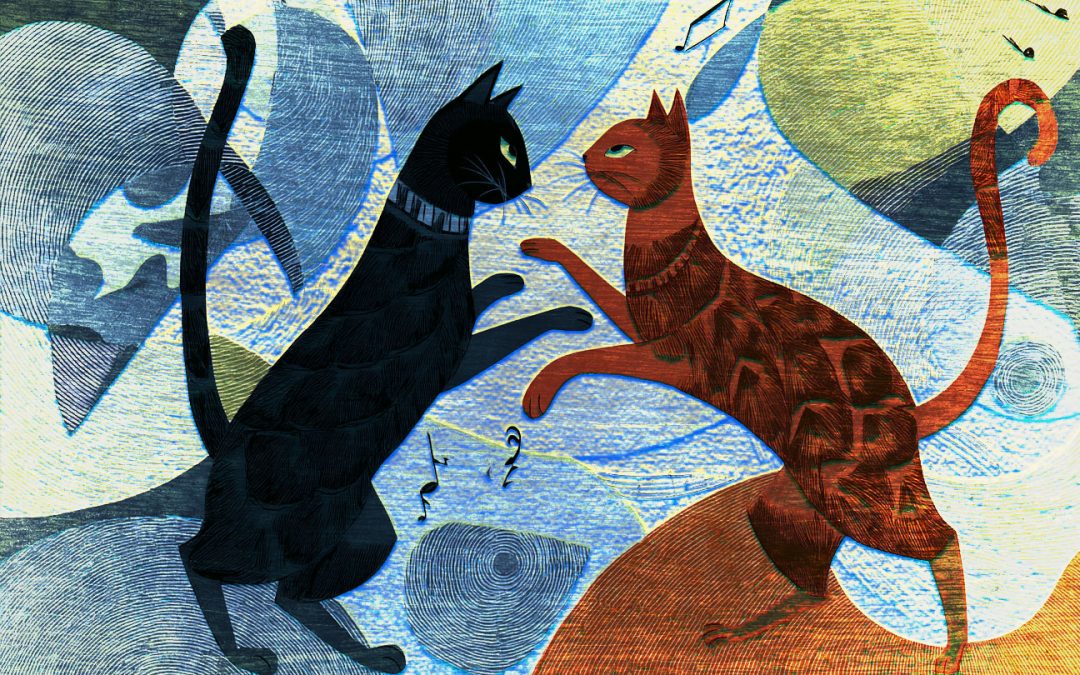
“There are two means of refuge,” said Albert Schweitzer, “from the misery of life — music and cats*.” To this I can attest. The cuddling my cat Grizzy gave me — when I got home from a trip last week to see my mom and stepdad, Don, in Florida — was an uncommon comfort after a long flight. And during my visit, I again witnessed the profound effect music can have.
Don, one of the loveliest and funniest men I’ve known, has Alzheimer’s disease (AD). Almost every afternoon Mom put on a DVD for him from the brilliant Doo Wop 50 collection (recorded in 1999 at The Benedum Center in Pittsburgh, PA) and we’d all three dance and sing along. Well, actually Don doesn’t dance much these days, but as he engages with the music he grew up with, he seems delighted and focused.
A 2022 study, The promise of music therapy for Alzheimer’s disease argues that “music interventions might be a promising means to delay and decelerate the neurodegeneration” of AD. It continues, “Music can be used as an effective cue to recall autobiographical memories and elicit strong emotions, often offering a meaningful way to connect with themselves and their loved ones.”
As heartbreaking as it is to see someone whom I love so dearly be confused and diminished, in those moments enjoying the music together we are decidedly connected and joyful. For that I am well and truly grateful.
See you on the dance floor —Sean Donovan
* From the essay Life thrums with music (Sep. 2025): The vibrational stimulation of a cat’s purr (20-27 Hz) “is thought to be healing for humans as well as for cats themselves. When humans are treated with frequencies of around 20-50 Hz, bone strength can be improved by up to 20 per cent… The range of a cat’s purr is known to relieve both chronic and acute pain… [and improve] blood circulation.”