
I hear the music, I feel the beat
And for a moment, when I’m dancing, I am free
—Free, Florence + The Machine
(from the album Dance Fever, also containing the song Choreomania)
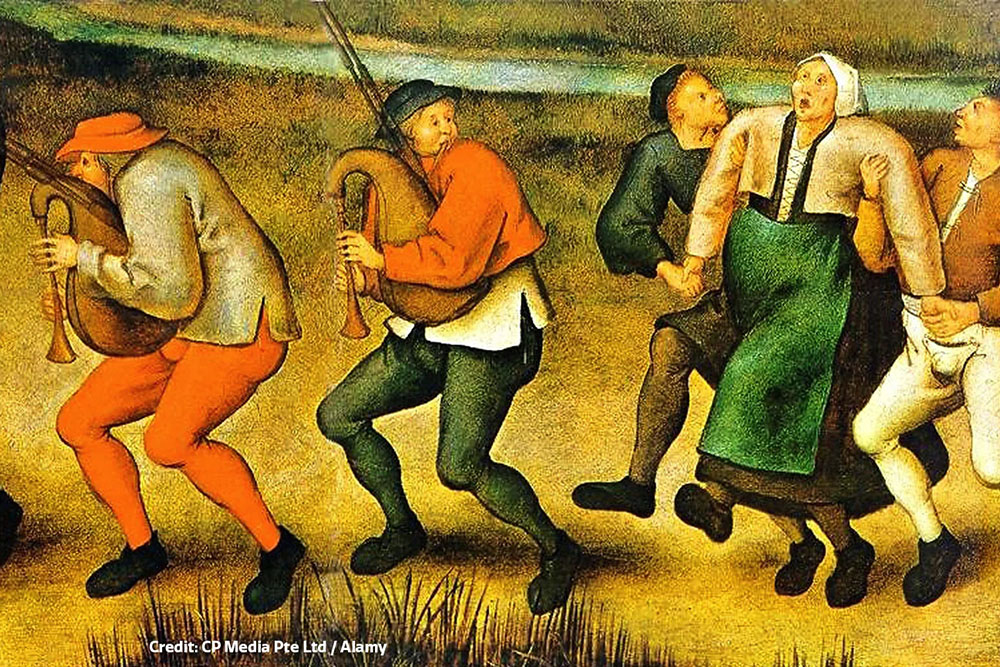
Around this time of year in 1374 — June 24 to be exact — a dancing plague gripped the town of Aachen, Germany. From Britannica’s “Today in History” series:
“Men, women, and children gathered in the streets. They writhed and leaped and twirled, often hand in hand. They screamed, they wept, they cursed, they prayed. But mostly, they moved. This continued for hours—even days—a wholly put-upon rave. Their bodies were bruised, their feet were bleeding, and still they danced, as if in a trance. It ended only when exhaustion won and participants collapsed.”
The dancing plague, known as choreomania, is “a phenomenon which occurred primarily in mainland Europe between the 14th and 17th centuries” (Wikipedia). An occurrence in July, 1518, in Strasbourg (modern-day France) was begun by a woman named Frau Troffea. Others joined her and, in an attempt to help the situation, musicians were called in, but that just encouraged more dancers. By August, as explained in the article “The people who ‘danced themselves to death'” (BBC, 12-May-2022), hundreds were captivated, with many perishing from their extreme exertions.
To this day, however, scholars still cannot explain what happened. Sebastian Brant, a Strasbourg cleric, blamed the devil for all this “giddy dancing gayly done” and averred that “dance and sin are one in kind.” Contrarily, in the more recent novel “The Dance Tree,” Kiran Millwood Hargave poses these incidents as spiritual revolt, writing “There is something soaring, hopeful: an abandonment.” What both these “psychic epidemic” instances had in common: Cataclysmic times, including actual plagues, extreme weather, floods and famine.
When the world appears to have gone completely mad, dancing with wild abandon would seem, to me, a quite reasonable response. Verily then, I beseech thee, find myriad suitable events for dancing listed online at the Dance Calendar.
See you on the dance floor —Sean Donovan