
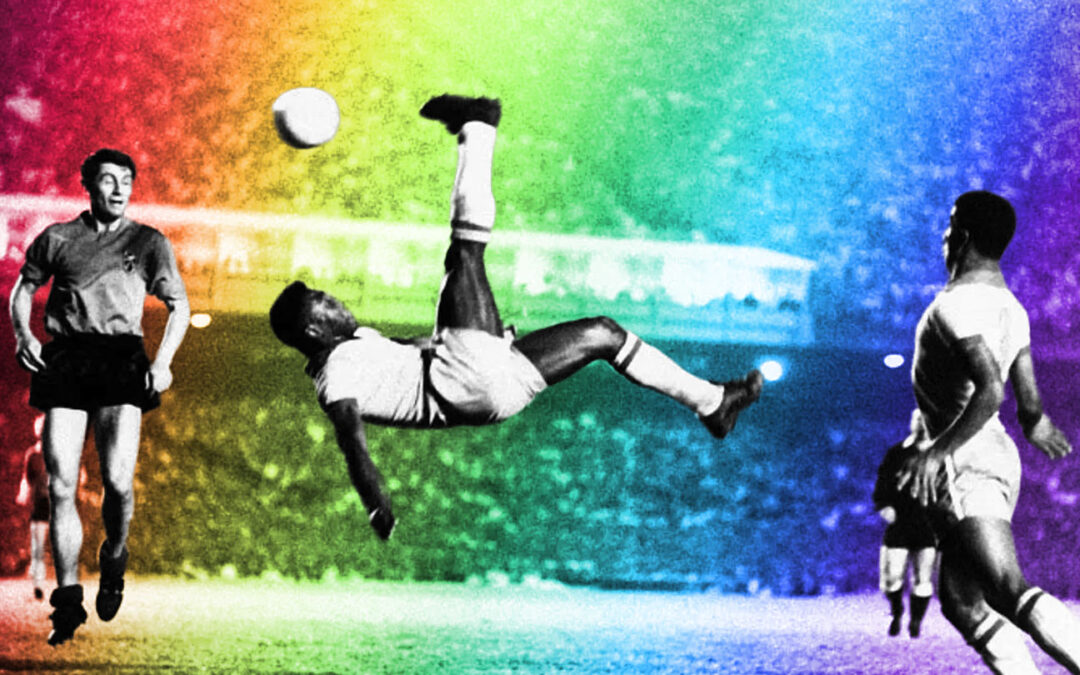
Pelé performing the bicycle kick
Football is an art, like dancing. It requires whole-hearted concentration.
— Arsène Wenger [football aka soccer]
“O Jogo Bonito,” a Portugese phrase popularized by the Brazilian footballer Pelé, is a reference to soccer (as we in the U.S. call it) which translates to “The Beautiful Game.” Watching highlights of the extraordinary 2026 World Cup athletes — with their exquisite proprioception skills — makes the phrase seem an apt assertion. Hurtling downfield while accurately kicking a ball is astonishing enough, while the bicycle kick, which Pelé executed with aplomb, is a sublime feat. Having the facility, while facing backwards, horizontal to the ground, to not only make contact with a moving ball but direct it into the goal requires next-level body awareness.
Sometimes referred to as the “sixth sense,” proprioception — from the Latin proprius, meaning “one’s own” — includes your body’s internal sense of position and movement in relation to its environment (see also the recent post Basketball grace and precision partnering). Extend out your arms, close your eyes and touch a finger to your nose. Success? That’s good proprioception at work. On a basic level, proprioception makes it possible for me, using qwerty typing skills learned in high school, to write this story. Each finger extends and contracts in proximity to the keyboard, so as to locate and press with precision the proper letters, while simultaneously coordinating its relationship to other fingers.
In a working paper regarding proprioception training for athletes (download PDF here), Angel Palacios describes techniques to help players intuit where the soccer ball is without directly using their eyes, just as a typist can learn to find keys without looking. “When two neural pathways can be used to perform an action, the brain usually focuses on the easier one,” says Palacios, meaning we generally default to vision. Restricting a sense or movement helps the brain build new neural pathways. For instance, in a person who’s lost motor skills in one arm caused by a stroke, a rehab technique is to bind the unaffected arm in a sling. “When the patient’s brain perceives that it cannot move the arm,” reports Palacios, “it resorts to the neural paths that guide movement of the affected arm and starts developing them again.” Years ago I noticed a related phenomenon, when using poor dancing technique caused knee injuries. By forcing me to restrict reliance on the knees, this eventually guided me to access the core and free up more dynamic hip movement, resulting in better body ergonomics.
Improving proprioception can help you find the beautiful dance! See four exercises for dancers to improve body awareness, below, and find numerous varied opportunities to practice your new skills online at the Dance Calendar.
See you on the dance floor —Sean Donovan
Exercises to help dancers improve proprioception, from the International Association for Dance Medicine & Science:
- At a minimum, dancers should be able to stand on one leg with their eyes closed for at least 30 seconds
- Stand on one leg and target eight points in space with the free leg, as shown here in the Star Excursion Balance Test
- Walk heel-to-toe (tandem) with eyes closed for a distance of 10 to 20 feet
- Walk at various speeds while multi-tasking (counting backwards from 100 by threes or carrying a full glass of water).