
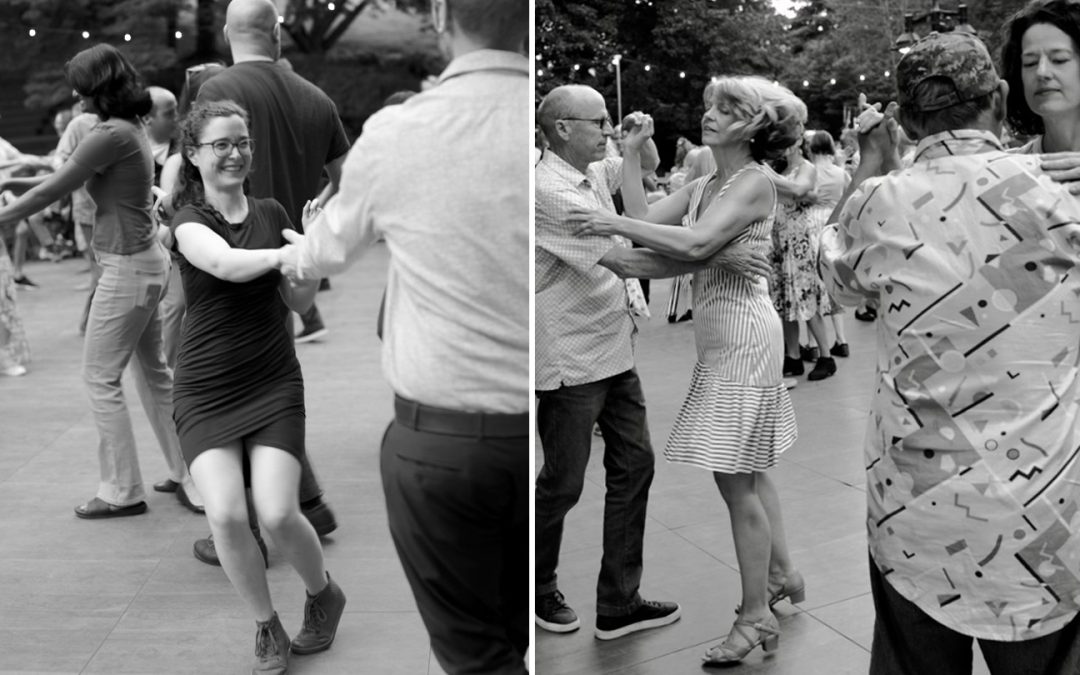
I’ve felt copious gratitude through the years, both specific and general, for this body that allows me to dance. I’ve never delved quite as deeply into the particular physiology, however, as does Tova Forman (Designed to Dance? Here’s What Science Says, July 14, 2025). What a delight to consider more deeply our intricate bodies.
“Dancing is only possible,” says Forman, “because of a complex set of engineering feats,” and she lists a few of them such as:
- My ankles and feet are wonders, built optimally for flexibility and stability. When my dance partner subtly rolls from his heel to his toe, I have a corresponding toe-to-heel roll that beautifully connects our movement. If I had a bird claw, or a horse’s hoof, or even a dog’s pad, this “simple” but elegant maneuver would be wrecked.
- My frame is a unique design. A good frame keeps dancers from stepping on each other’s toes and knocking knees. “The hand’s attachment to the end of a highly mobile appendage about two-and-a-half feet long — the human arm — further contributes to its universal utility.” (The Miracle of Man, pp. 193-194)
- My proprioceptors and vestibular balancing mechanism are miraculous. [Even with eyes closed, dance] partners can pick up on each other’s position, direction, step size, speed, timing, and even (to a degree) location in the room. Your senses send signals to and from your brain to accomplish this, neither stinting on relevant information nor flooding the system with too much at one time.
- My respiratory system is a dream. My brain and blood require plenty of oxygen every day of the week, but at a Lindy Hop dance, I suddenly need more — and my lungs kick in to do the job. When I’m done dancing, my breathing returns to normal to keep me from getting dizzy from oxygen. If I decide to dance every evening day in day out, my body adjusts to my new needs.
Get your ankles on the dance floor. —Sean Donovan
Constance Brinkley photos (above)